


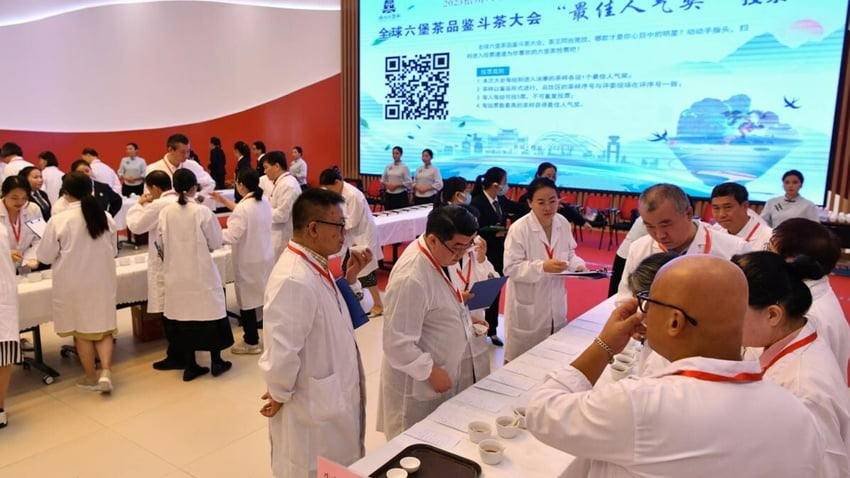
At the 2023 Global Liubao Tea Tasting in China (Photo: Courtesy of the Wuzhou Tea Industry Development Service Center)
The Global Liubao Tea Tasting Competition took place this month in Wuzhou, South China's Guangxi Zhuang Autonomous Region.
A total of 541 samples were submitted for the contest, and a large number of tea companies from China competed, with international participants from Malaysia, Vietnam and Singapore.
The samples were divided into 14 groups and were judged and rated by a team of domestic and international tea experts and Liubao tea collectors. A group of 55 seven-star “Kings of Tea” were chosen as a result.
According to the Wuzhou Tea Industry Development Service Center, Liubao tea originates from Liubao Town in Wuzhou of Guangxi Zhuang Autonomous Region, which has an environment and climate conditions that are ideal for the growth of tea shrubs.
During the reign of the Jiaqing Emperor of the Qing Dynasty, Liubao tea was acclaimed for its “areca nut scent,” characterized by “redness, richness, purity and aged aroma.” It emerged as one of China's top teas and its consumption swept across the land.
Towards the end of the Qing Dynasty, droves of Chinese labors traveled across the South China sea to find work abroad, and the thirst-quenching, stomach-nourishing and other healthy properties of Liubao tea, as well as its long shelf life, made it a favorite among overseas Chinese, hence its eventual rise in popularity among tea-drinkers in countries such as Malaysia and Singapore.
Research results from a health and nutritional study – conducted by a team led by the Academician of Chinese Academy of Engineering and Professor at Hunan Agricultural University, Liu Zhonghua – explain the functionality and scientific mechanisms behind numerous benefits associated with Liubao tea. Some of these benefits include fat and weight reduction, blood sugar reduction, uric acid suppression, liver health, intestines and stomach coordination, anti-aging and anti-inflammatory functions, protection against radiation and immunity improvement.
Guo Junbang, president of the Liubao Tea Association of Malaysia, one of the judges on the Modern Processing Technique Panel for the final of this year’s competition, said, “This tea competition plays a huge role conducive to the advancement of the Liubao tea industry, and I hope that the competition will continue to be hosted.”
Junbang added: “Liubao tea culture has integrated into the daily life of Malaysians, and Liubao tea is often our drink of choice when we eat or enjoy afternoon tea. After attending this competition, I genuinely hope to share with everyone the Liubao tea cultural similarities and differences, and the tea's various consumption experiences, in other parts of the world, and I also hope that Chinese tea enterprises can produce more good teas so that more people can learn about and fall in love with Liubao tea.”
Liao Zifang, president of the Hong Kong Teaism Alliance and a judge on the Modern Processing Technique Panel of the final for this year's tea competition, said that tea competitions are a crucial part of tea science, as tea competitions can push enterprises to ceaselessly improve production technique and raise product quality.
Zifang hopes that Wuzhou can maximize the unique advantages of Liubao tea, such as its special aroma and unique health benefits, and continue to develop markets and strengthen the Liubao cultural brand.
Canadian Ms. Liu, after learning about the Global Liubao Tea Tasting Competition, decided to take her whole family to the event to expand their horizon. She said: “Our family has been living and studying in China for a year now, but we've never been to a tea competition before. The atmosphere was incredible, and we've been able to learn about the diversity in tea culture.”
Source From: World tea news